
The foreign exchange (forex) market is vast and volatile, driven by a constant stream of news, data, and sentiment. For traders, navigating these waters requires tools that offer clarity amidst the noise. This is where technical indicators come in.
Forex indicators are mathematical calculations based on a currency pair’s price and/or volume. They are plotted on a chart to help traders identify signals and trends, gauge market conditions, and make more informed decisions about when to enter or exit a trade.
However, a common mistake among traders—especially beginners—is overloading their charts with too many indicators, often from the same category, which leads to confusion and “paralysis by analysis”. The key to success lies not in quantity but in strategic selection and purposeful combination.
Understanding the Four Core Categories of Indicators
Before adding any indicator to your chart, it is crucial to understand its primary function. Indicators are typically classified into four broad categories, each answering a different question about the market.
A Deep Dive into the Top Forex Indicators
While the list of available indicators is long, a few have stood the test of time due to their reliability and versatility. Here’s a closer look at five of the most essential tools for any trader’s toolkit.
1. Moving Averages (MA & EMA)
The cornerstone of trend analysis. A Moving Average smooths out price data to reveal the underlying direction. A common strategy is to watch for a “Golden Cross,” where a shorter-term MA (like the 50-period) crosses above a longer-term MA (like the 200-period), signaling a potential uptrend.
2. Relative Strength Index (RSI)
This momentum oscillator moves between 0 and 100. Readings above 70 typically indicate an overbought market (potentially ready for a pullback), while readings below 30 signal an oversold market (potentially ready for a bounce). However, in strong trends, the RSI can remain in overbought or oversold territory for extended periods, so it’s best used with other confirming signals.
3. Moving Average Convergence Divergence (MACD)
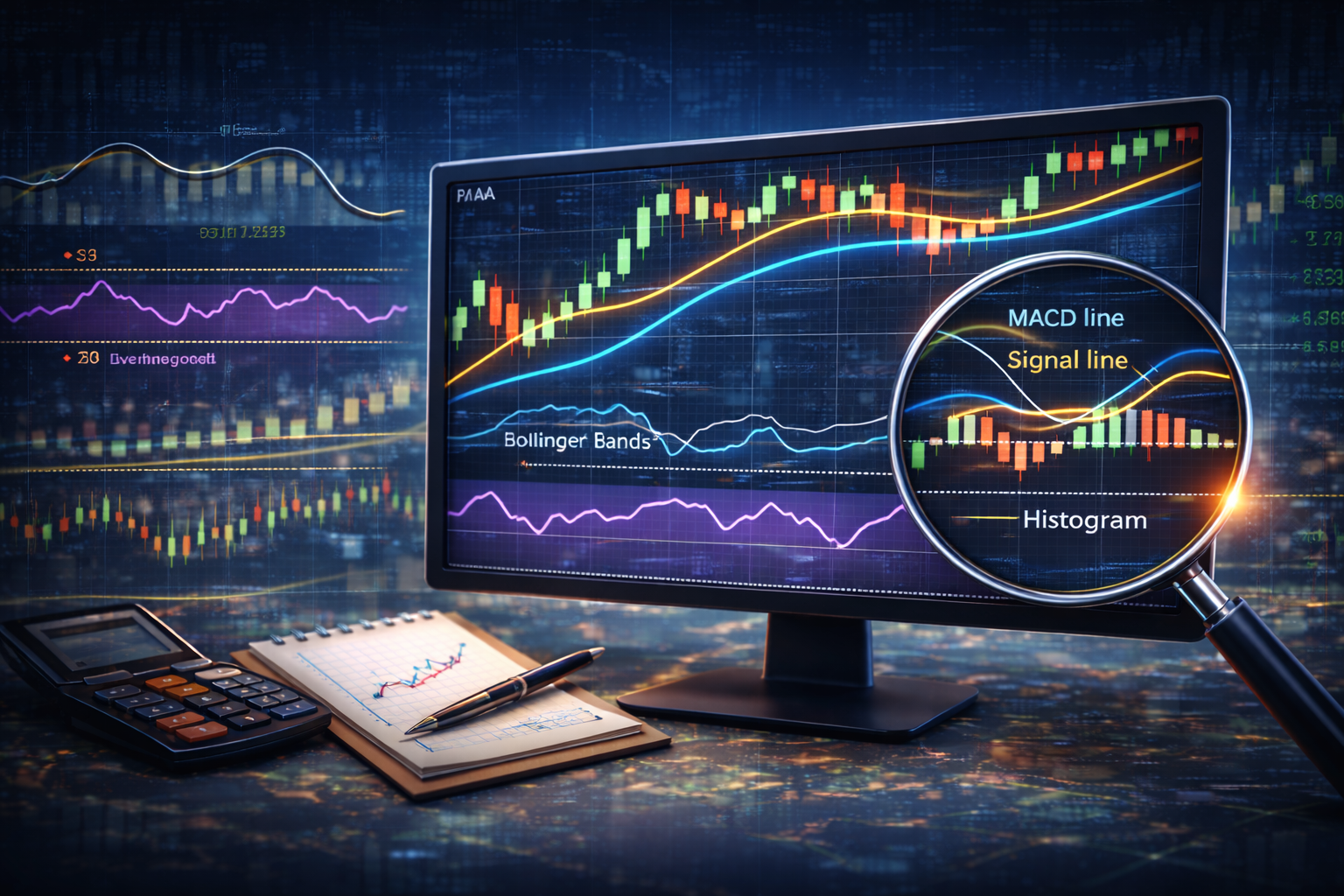
A versatile tool that combines trend and momentum analysis. It consists of two lines: the MACD line and a signal line. When the MACD line crosses above the signal line, it can be a buy signal; a cross below can be a sell signal. The MACD is particularly powerful for spotting divergences, where the price makes a new high but the MACD does not, warning of a potential trend reversal.
4. Bollinger Bands®
This volatility indicator consists of a simple moving average (the middle band) with an upper and lower band representing standard deviations. The bands expand during volatile markets and contract during calm periods. Price touching or breaching a band can indicate over-extension, while a “squeeze” (narrowing bands) often precedes a significant breakout.
5. Average True Range (ATR)
Unlike directional indicators, the ATR measures pure market volatility—how much a currency pair is moving on average. It is invaluable for risk management. A high ATR suggests you should widen your stop-loss to avoid being stopped out by normal market noise, while a low ATR allows for tighter stops.
The Pro’s Guide to Combining Indicators
Simply picking great indicators isn’t enough. The true art of technical analysis lies in combining them to build a robust trading thesis. The fundamental rule is: combine indicators from different categories, not the same one.
Avoid Redundancy: Using two momentum indicators like the RSI and Stochastic on the same chart doesn’t give you new information; it just gives you the same signal twice, which can lead to overconfidence and missed contradictory clues from the price itself.
The Complementary Approach: A powerful strategy combines indicators that play distinct roles. For example:
- Identify the Trend: Use a 200-period Moving Average. If the price is above it, look for long opportunities.
- Find an Entry Zone: Use RSI to spot oversold conditions (below 30) during that uptrend, signaling a potential pullback to buy into.
- Manage the Trade: Use ATR to set a logical stop-loss distance based on current volatility, protecting your capital.
This approach creates a logical filter: only trade in the direction of the larger trend (MA), wait for a favorable momentum setup (RSI), and manage risk according to the market’s current temperament (ATR).
Common Mistakes to Avoid
- Indicator Overload: Sticking to 2-4 complementary indicators is far more effective than cluttering your screen with a dozen conflicting lines.
- Ignoring Price Action: Indicators are derived from price and therefore lag behind it. Always pay attention to the raw price chart, support/resistance levels, and candlestick patterns for context.
- Searching for a “Holy Grail”: No single indicator is 100% accurate. The goal is to find a combination that increases your probability of success, not one that guarantees it.
- Neglecting Fundamentals: Major economic announcements or geopolitical events can override any technical signal. Always be aware of the economic calendar.
Conclusion
The “best” forex indicator is the one that fits your trading style and, more importantly, the one you understand how to use in concert with others. Success in 2026’s markets won’t come from a secret, complex formula, but from a disciplined application of a few core principles: using trend indicators to determine your bias, momentum indicators to time your entry, and volatility tools to manage your risk.
