
Navigating the Fractured Future: An Investor’s Guide to the New World Order
“People couldn’t buy houses. You have these big companies buying thousands and renting them out. We want people to be able to buy a home,” President Trump told CNBC, outlining his economic policy in an interview from Davos on January 21, 2026.
The discourse from the Trump administration in 2026 is redefining the rules of geopolitics and the global economy, ushering in an era of technological competition and trade tensions. The race for Artificial Intelligence (AI) and the procurement of critical raw materials are becoming the new frontiers of national power, in a context where the lines between economics and strategy are increasingly blurred.
1. The “Trump Effect”: Politics, Markets, and the Reorganization of Alliances
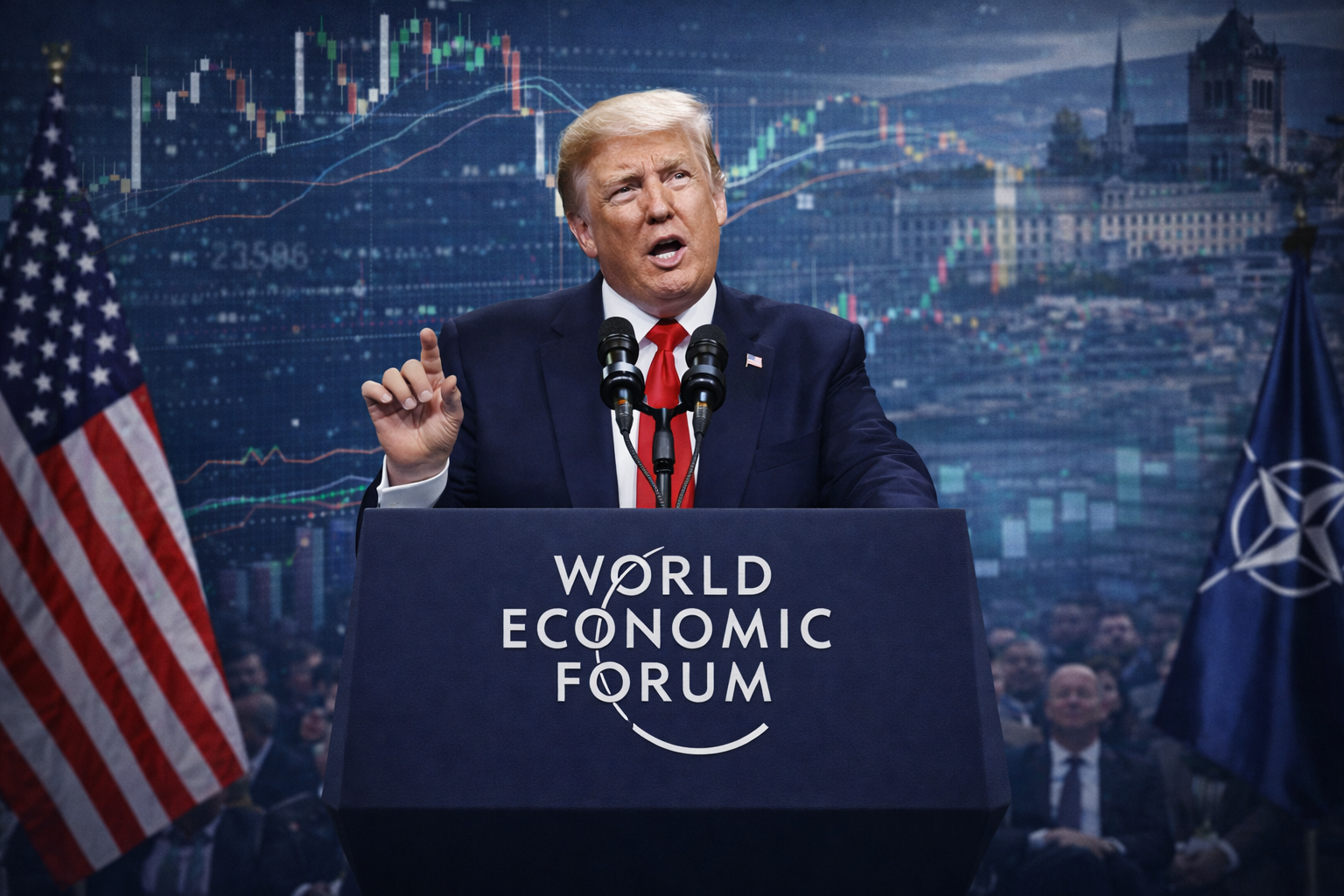
President Donald Trump’s intervention at the World Economic Forum in Davos was a clear indicator of his administration’s agenda for 2026. His statements blended domestic economic debate, international controversy, and a reinterpretation of transatlantic relations.
Interventions on Domestic Policy and Criticism of the Fed
Trump focused on two key domestic economic proposals:
- Interest Rate Cap: He reiterated his support for a temporary 10% cap on credit card interest rates, calling it an idea he “loves”.
- Housing Crisis: He criticized large investment firms, accusing them of pricing American families out of homeownership, and announced an executive order to limit such bulk purchases.
His most direct criticism, however, was aimed at Federal Reserve Chairman Jerome Powell. Trump accused him of being “incompetent or crooked” due to massive cost overruns in the Fed’s headquarters renovation. He further announced he was close to deciding on a successor for the central bank’s top role.
The Greenland Issue: Mineral Geopolitics
The biggest surprise came with the announcement of a “concept of a deal” with NATO on Greenland. Trump stated the agreement, which would last “forever,” concerns mineral rights and involvement in the “Golden Dome.” This strategic interest in Arctic resources is driven by melting ice, which is opening new trade routes and making mineral deposits accessible.
This move follows tensions with several European allies, including tariff threats, and is seen as an attempt to consolidate US influence in the Arctic at the expense of China and Russia.
Foreign Policy: Warnings and Endorsements
On foreign policy, Trump warned Iran it “can’t do the nuclear,” claiming a previous warning from him had halted mass executions in the country. He also announced that Venezuela would receive a share of the proceeds from the sale of Venezuelan oil seized by the US. Simultaneously, he did not spare sharp criticism for several leaders, including French President Emmanuel Macron and Canadian Prime Minister Mark Carney.
2. Geopolitics, AI, and the New Cold War for Critical Minerals
2026 is shaping up to be a year where geopolitics, AI investments, and supply chain security are deeply intertwined.
The Global AI Race and US-China Competition
Artificial Intelligence is no longer just a technological topic but a matter of national security and global competitiveness. Global investment in AI infrastructure is expected to reach $400 billion by 2030.
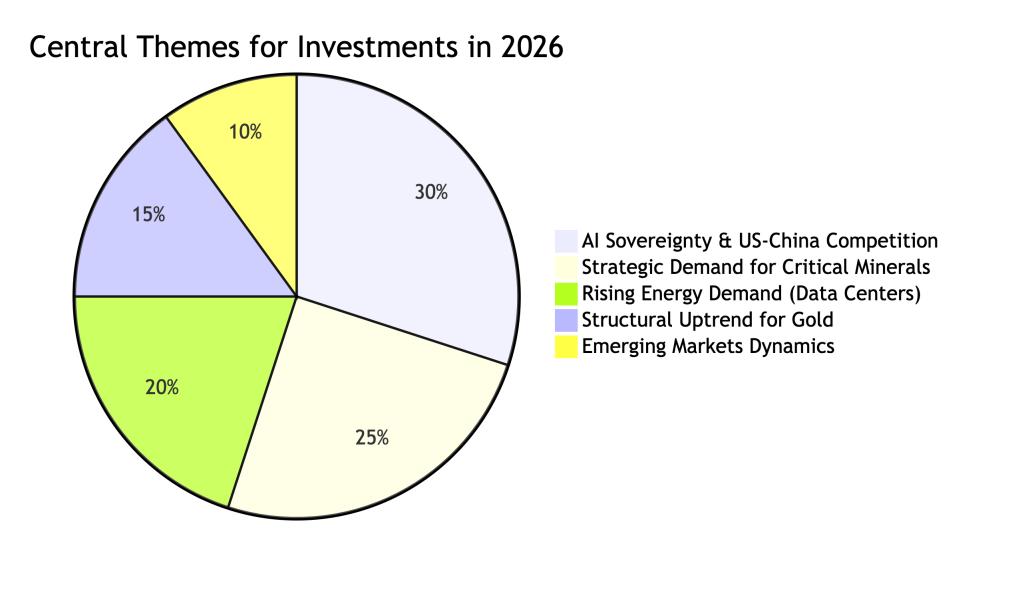
This race has created a technological bipolarization. The United States maintains leadership, but China, driven by the need for semiconductor autonomy and the launch of models like DeepSeek, is establishing itself as the only serious competitor. The rivalry extends to control over foundational technologies, with the future of Taiwan and access to semiconductor materials becoming issues of global stability.
The Critical Minerals Front
The energy transition and the AI boom are generating unprecedented demand for critical minerals (such as lithium, cobalt, rare earths). This is not cyclical but strategic demand: nations are stockpiling to ensure supply security in case of geopolitical disruptions. The United States, recognizing its dependence on China, is pursuing an aggressive policy of diversification and accumulation. It is in this context that the maneuvers regarding resource-rich Greenland must be understood.
Gold and Financial Stability in an Unstable World
In a scenario of heightened geopolitical tensions, trade wars, and supply chain fragmentation, gold has resumed its traditional role as a safe-haven asset. After an exceptional 2025, its price is supported by structural factors: central bank demand and the uncertainty of an increasingly multipolar world.
3. Implications for Investors: Opportunities and Risks in a Fragmented World
For investors, the new landscape demands a shift in perspective: geopolitics is no longer background noise but a fundamental capital allocation factor.
Areas of Opportunity and Growth
- The Entire AI Value Chain: Investments are broadening beyond pure tech giants. Significant opportunities lie in semiconductors, data center infrastructure, and the energy needed to power them.
- Energy and Electrification: The structural growth in electricity demand, driven by data centers and the energy transition, benefits the entire value chain, from utilities to equipment manufacturers.
- Selective Emerging Markets: Some well-positioned emerging markets, such as South Korea, Taiwan, and Malaysia, can benefit from the demand for AI hardware. In Latin America, countries exporting critical minerals (like Chile for copper) may gain from the strategic demand.
Risks and Portfolio Considerations
- Geopolitical Volatility: Uncertainty over US-China relations and trade tensions can cause sudden market shocks.
- Concentration and Valuations: Returns will not be uniform. The extraordinary performance of US tech has raised questions about excessive valuations, making selection crucial.
- Sovereign Debt and Credit Stress: Despite a positive macro outlook, high public debt in many advanced economies is an underlying risk. A growth slowdown or rising rates could put pressure on credit markets.
4. The Macroeconomic Picture: Two-Speed Growth
Forecasts for 2026 depict a two-speed world, with the United States clearly ahead thanks to AI investments and fiscal stimulus.
- United States: GDP growth is forecast at 2.25%, supported by AI investments. Inflation is expected to remain moderately above the 2% target, limiting the Fed’s room for aggressive rate cuts.
- China: Growth is estimated at 4.5-5.0%, above consensus, driven by strong momentum in technological innovation. However, domestic demand fragilities persist.
- Europe and the United Kingdom: Prospects are more modest, with growth forecast at 1.0% and 0.8%, respectively. The region is less exposed to the AI investment cycle and more vulnerable to trade tensions.
Conclusion
2026 is shaping up to be a year of transition toward a new international economic order. The era where trade and finance operated in a relatively stable and integrated global framework appears to be ending. In its place, a landscape of strategic competition, fragmentation of value chains, and realignment of alliances around key technologies and resources is emerging.
For investors, companies, and governments, success will depend on the ability to navigate this complexity, distinguishing long-term growth opportunities from the risks of a world increasingly divided into blocs. The marathon for technological and economic supremacy has just begun, and its rules were clearly written on the stages of Davos.
