
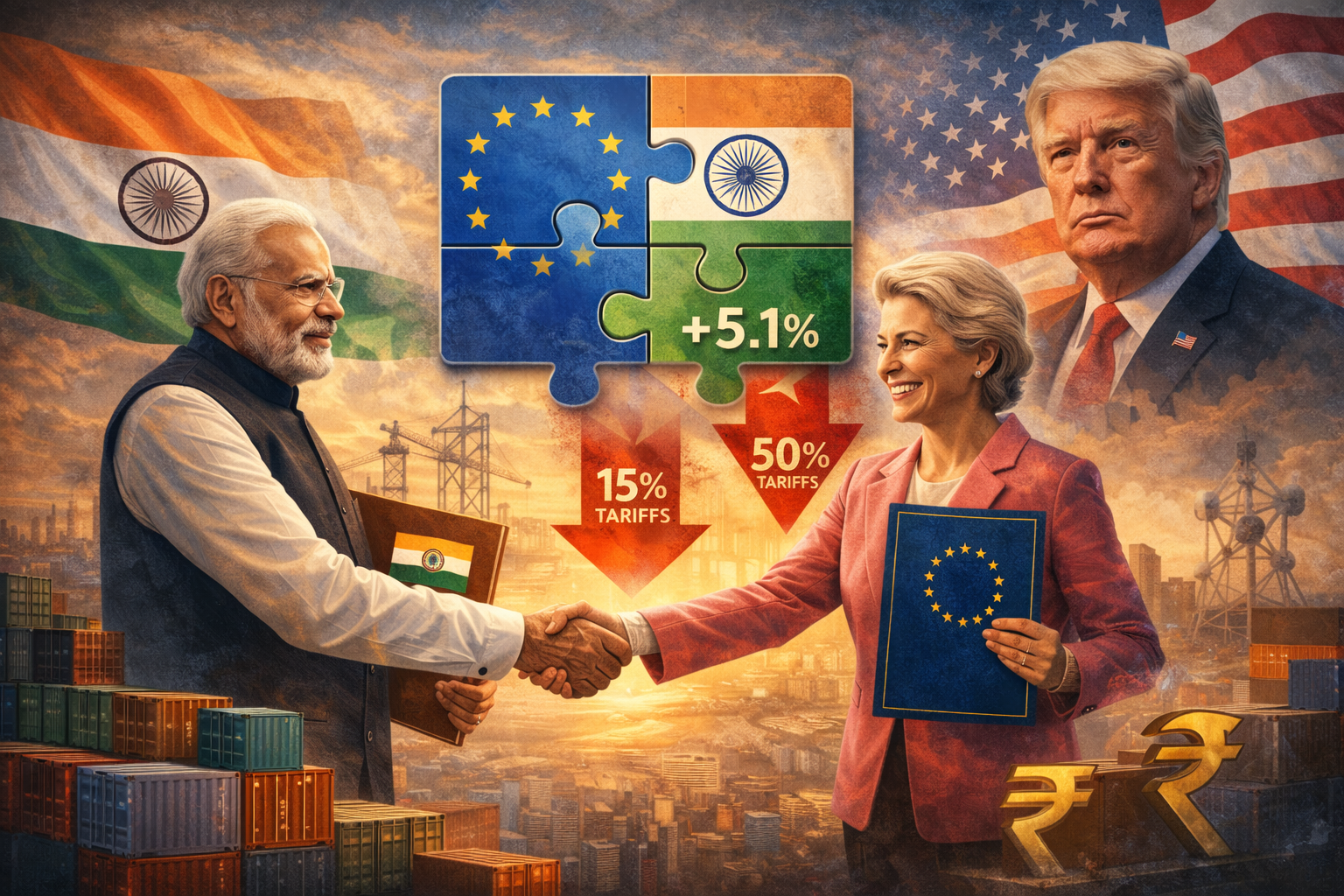
In the early hours of Tuesday, January 27, 2026, global trade turned a historic page. The European Union and India, after a grueling two-decade-long negotiation marathon, finally sealed what their leaders are proudly calling the “mother of all deals.” This landmark free trade agreement (FTA) is far more than a dry economic pact—it’s a bold geopolitical chess move, strategically positioned as a direct counterbalance to the unpredictable trade winds blowing from Washington.
While Brussels and New Delhi celebrate, a single, looming question dominates corridors of power from Berlin to Delhi to Wall Street: How will President Donald Trump react?
The Anatomy of a Mega-Deal
At its core, the agreement promises to gradually dismantle trade barriers, slashing tariffs to zero on the vast majority of goods flowing between the world’s largest trading bloc and its fifth-largest economy. It’s a win born of mutual necessity.
For the EU and India, both facing punitive U.S. tariffs—a 15% levy on European goods and a staggering 50% on many Indian imports—this deal is a lifeline. It diversifies their markets, secures supply chains, and provides a critical buffer against American trade volatility.
“This is probably one of the best deals they can do at the moment,” observed Hosuk Lee-Makiyama of the European Centre for International Political Economy. “With the U.S. and Chinese markets relatively closed, the EU and India have opened a crucial new door for each other.”
The Elephant in the Room: Awaiting Trump’s Move
The deal’s ink is barely dry, but the pre-emptive criticism has already begun. U.S. Treasury Secretary Scott Bessent set the tone days before the signing, framing the pact as a betrayal of allied solidarity.
“The U.S. has made much bigger sacrifices than Europeans have,” Bessent stated pointedly on ABC News. “We have put 25% tariffs on India for buying Russian oil. Guess what happened last week? The Europeans signed a trade deal with India.”
This rhetoric signals a White House likely to view the agreement not as a victory for free trade, but as an end-run around its America First agenda. The potential responses on the table range from fiery public condemnation to, more worryingly, a new escalation of tariffs.
India’s Diplomatic Dance: Between an Old Friend and a New Partner
For Indian Prime Minister Narendra Modi, this deal is a crowning achievement. It delivers massive economic opportunity while elevating India’s status as a sovereign pillar in a multipolar world, no longer content to be merely a swing state between the U.S. and China.
Yet, New Delhi is walking a tightrope. Officials are quick to downplay any notion of strategic rivalry with Washington. “The relationship structure is very strong… everybody needs to chill a bit,” remarked India’s Petroleum Minister Hardeep Singh Puri, emphasizing ongoing U.S.-India trade talks.
This careful messaging reveals India’s delicate balancing act: securing a transformative deal with Europe while desperately trying to prevent a volcanic reaction from its strategic partner in Washington.
Why This Deal Changes Everything
The ripple effects of this agreement will be felt far beyond customs forms:
- The Hedge Is Official: This pact formalizes a global economic “hedge” against U.S. unilateralism. Nations are now proactively building architectures that reduce their vulnerability to American tariff threats.
- The Rise of the Middle Powers: The EU-India axis demonstrates that middle powers, when aligned, can set the trade agenda, challenging the dominance of traditional superpowers.
- A Blueprint for Others: Success here will likely trigger a domino effect. Other nations in the Indo-Pacific and beyond may now accelerate their own trade talks with either bloc, leading to a rapid reorganization of the world’s economic alliances.
The Bottom Line
The “mother of all deals” is a watershed moment. It signals that in the face of protectionist storms, other major economies are not waiting idly—they are building new ships and sailing in new formations.
All eyes are now fixed on Mar-a-Lago and the White House. Will President Trump see this deal as a provocation, triggering a new trade war front? Or will it serve as a wake-up call, pushing the U.S. back toward a strategy of engagement and coalition-building?
The future of global trade may well depend on the answer.
