
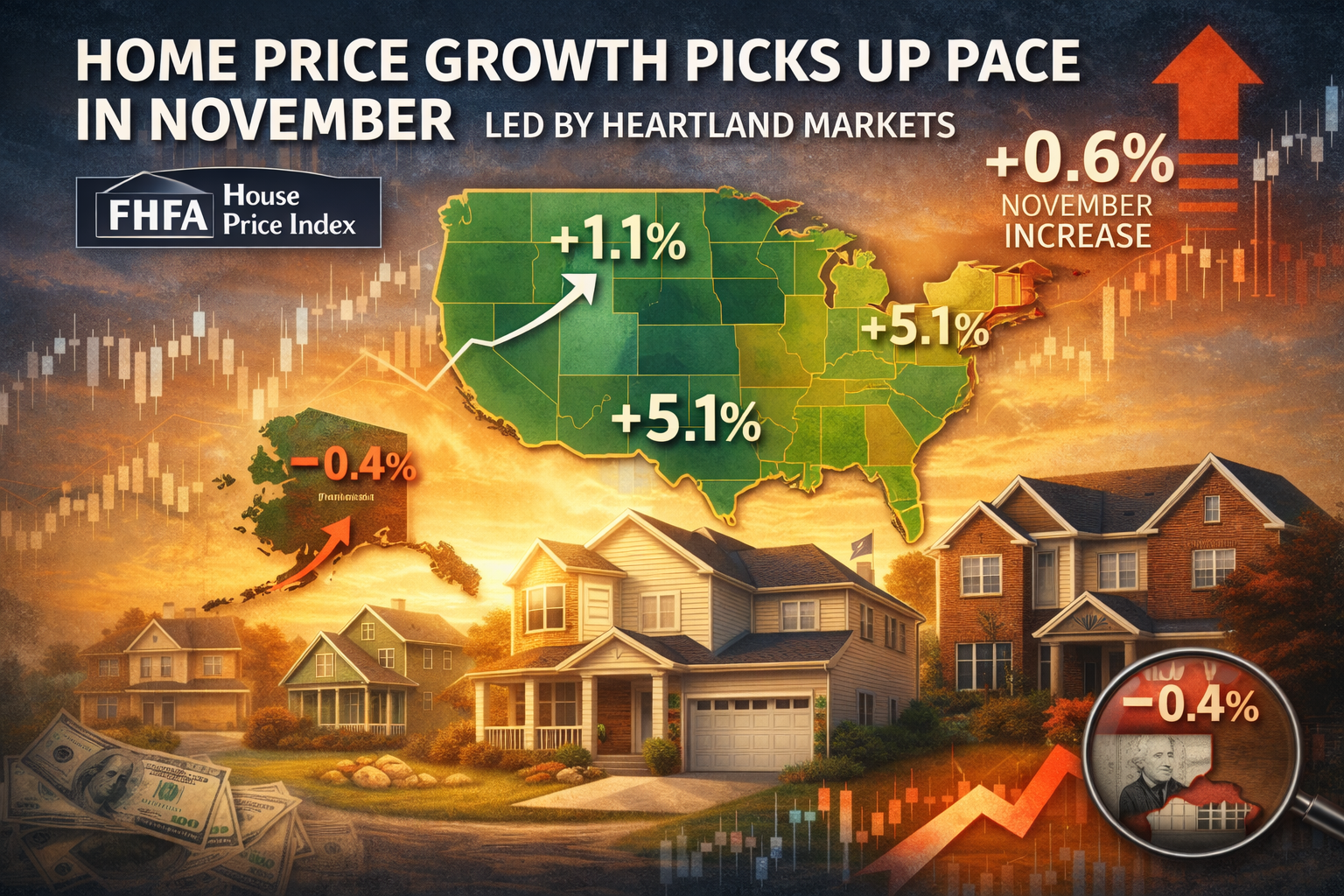
WASHINGTON, D.C., January 27, 2026 – The U.S. housing market showed signs of gathering momentum in November, with home prices rising 0.6% from the previous month, according to the Federal Housing Finance Agency’s (FHFA) seasonally adjusted House Price Index (HPI) released today. The increase, which follows a 0.4% gain in October, brings the year-over-year appreciation rate to 1.9%, signaling a period of steady, moderate growth for the national market.
The headline figures, however, mask a deeply fragmented landscape where regional economic strength and affordability are creating clear winners and losers.
A Nation Divided: Regional Performance Gap Widens
The monthly data from the nine U.S. census divisions reveals a tale of two housing markets. Growth was strongest in the nation’s more affordable interior, while coastal markets facing higher costs showed little momentum or continued declines.
🔺 Top Performers (Monthly Change):
- East South Central Division (AL, KY, MS, TN): +1.1%
- West South Central Division (AR, LA, OK, TX): +0.9%
- East North Central Division (IL, IN, MI, OH, WI): +0.8%
➡️ Stable/Lagging Markets:
- Middle Atlantic Division (NY, NJ, PA): 0.0%
- New England Division (CT, MA, ME, NH, RI, VT): +0.2%
The 12-month story is even more striking. The East North Central Division led the nation with a powerful 5.1% annual gain, demonstrating sustained demand in the industrial Midwest. In stark contrast, the Pacific Division (CA, OR, WA, HI, AK) remained the only region in negative territory, with prices down 0.4% from November 2024.
The Indicator Behind the Numbers: Why the FHFA HPI Matters
The FHFA HPI is a critical gauge of the U.S. single-family housing market, distinct from other price measures. Its authority comes from its repeat-sales methodology, which tracks price changes on the same properties over time using data from millions of mortgages backed by Fannie Mae and Freddie Mac. This approach eliminates distortions from shifts in the types or sizes of homes sold each month, providing a purer measure of market appreciation.
“The November acceleration suggests the housing market is normalizing into a sustainable groove,” noted Financial Analyst Michael Chen. “We’re seeing a reversion to fundamentals—markets with stronger job growth relative to housing costs are pulling ahead, while high-cost areas are in a corrective phase.”
Market Forces at Play: Inventory and Affordability
The persistent price growth occurs against a complex economic backdrop:
- Stubbornly Low Inventory: The supply of existing homes for sale remains near historic lows, creating a floor under prices despite affordability challenges.
- The “Lock-in” Effect: Homeowners with ultra-low mortgage rates from previous years are reluctant to sell, further constraining supply.
- Regional Migration: Data continues to show population inflows to more affordable divisions in the South and Midwest, directly fueling housing demand.
Looking Ahead: What to Watch in 2026
The regional divergence is expected to persist in the coming months. Markets in the East North Central and South Central divisions are likely to continue outperforming, while the Pacific and Northeast face a longer path to recovery. The key variable remains the trajectory of mortgage rates, which will either ease or exacerbate existing affordability pressures.
The next FHFA HPI report, scheduled for February 24, 2026, will provide data through December and a comprehensive summary of the fourth quarter of 2025, offering critical insight into whether the year-end momentum carried through the holidays.
For investors and industry professionals, the message is clear: national housing trends have fractured. Success now requires a targeted, region-by-region understanding of local economic drivers and inventory dynamics.
Financial journalist covering real estate markets and economic policy.
